Photos by Victoria Eisenberg
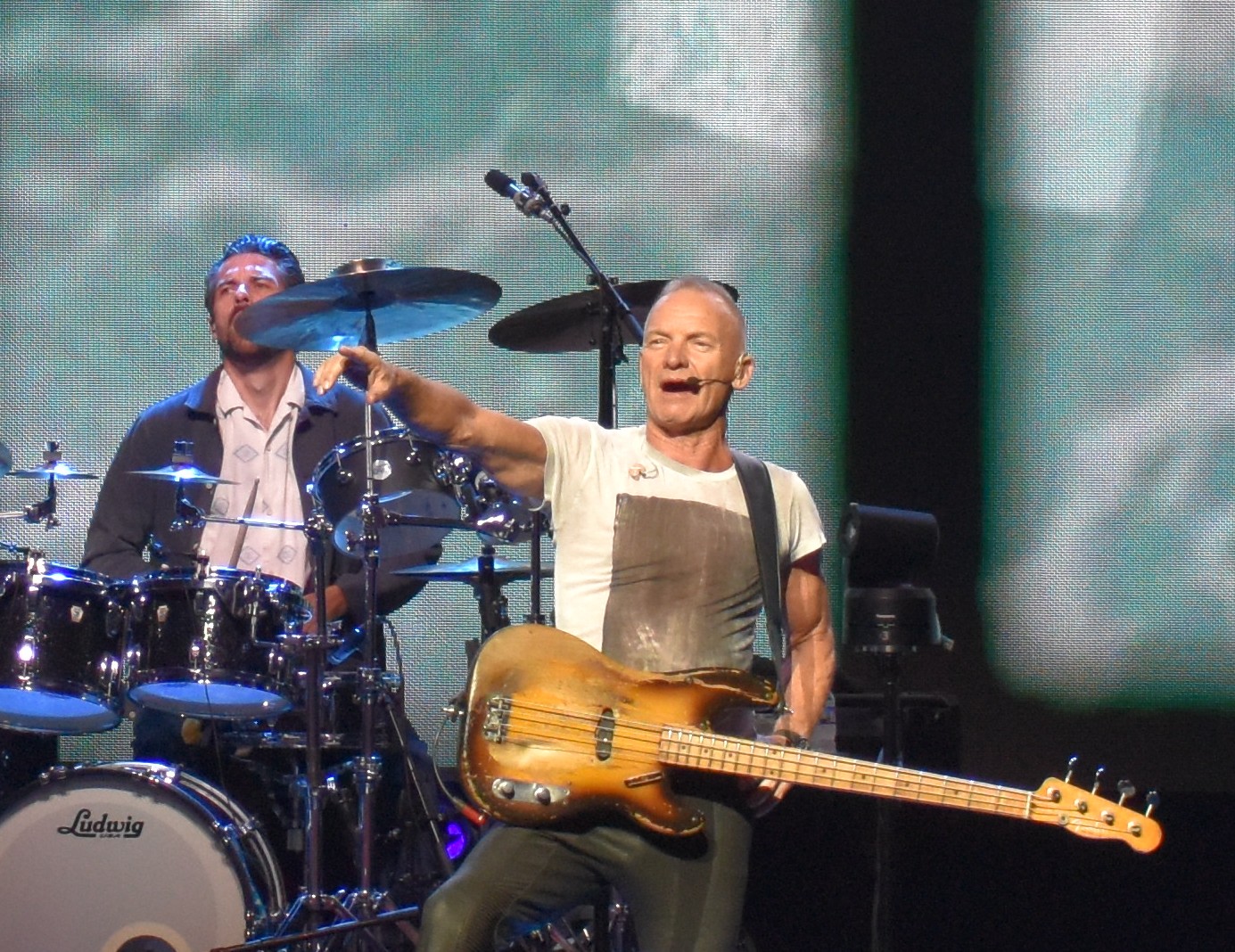
The legendary Sting returned to the DMV this weekend for the first of three unforgettable nights at Wolf Trap’s Filene Center, proving once again that great songs need little more than exceptional musicians to bring them to life. Armed with his signature bass, a guitarist, a drummer, and one of the most celebrated catalogs in rock history, Sting delivered a masterclass in musicianship, reminding the audience that his music has stood the test of time for more than four decades.
Of the countless artists I’ve seen and covered over the years, Sting continues to rank among the very best. His inventive bass lines, unmistakable voice, and ability to tell compelling stories through song remain as captivating today as ever. At 74 years young, he looks fantastic and performs with an energy and precision that rival artists half his age. Returning to the DMV for the second stop of his Sting 3.0 World Tour, he and his powerhouse trio turned a rainy Thursday night at the Filene Center into an unforgettable evening of timeless music. (Editor’s note – this review reflects the first of three nights of the tour stop in Vienna, VA)
The concept was deceptively simple: Sting on bass and vocals, longtime collaborator Dominic Miller on guitar, and Chris Maas on drums. What looked minimalist on paper became something far richer onstage. Sting redefined the music, stripping away layers while revealing the strength of the songs themselves.

The trio format naturally echoed The Police, where bass, guitar, drums, and carefully placed silence created as much impact as any wall of sound. From the opening chords of “Message in a Bottle,” it was obvious this wasn’t a nostalgia tour built on recreating familiar recordings. Instead, Sting treated his catalog as living music, reshaping each song while preserving its unmistakable identity.
Newer material like “I Wrote Your Name (Upon My Heart)” blended seamlessly with classics including “If I Ever Lose My Faith in You,” “Englishman in New York,” “Walking on the Moon,” “Wrapped Around Your Finger,” “King of Pain,” and “Every Breath You Take.” Familiar arrangements gave way to leaner interpretations that emphasized groove, dynamics, and the enduring quality of Sting’s songwriting.
At the center of it all was Sting’s distinctive bass playing. Watching him closely revealed just how much his technique contributes to his unmistakable sound. Rather than using a pick or relying on traditional fingerstyle, he attacks the strings primarily with a downward thumb stroke, occasionally punctuating phrases with his index finger. Combined with the steep upward angle of his bass, the approach produces the warm, rounded tone that has long anchored his reggae-influenced grooves. It’s an elegant piece of musicianship: efficient, economical, and remarkably effective. Even after decades onstage, his bass lines remained locked in while his voice retained its clarity and control.
Dominic Miller once again proved why he has remained Sting’s musical partner for more than three decades. In a power trio, the temptation is to fill every available space. Miller understood that these timeless classics needed exactly the opposite. Playing his familiar Fender Stratocaster, he favored clean articulation, atmospheric textures, and impeccable phrasing over flashy solos.
That restraint became one of the evening’s greatest strengths. On “Fields of Gold,” “Mad About You,” “When We Dance,” and “Never Coming Home,” Miller’s guitar added color, tension, and emotional depth with remarkable precision. His performance served as a reminder that great guitar playing is knowing which notes truly matter in a song.

Chris Maas faced perhaps the evening’s most demanding role. Bridging songs that span five decades and multiple musical styles requires more than technical ability—it demands musical instinct. Rather than replicating Stewart Copeland’s iconic Police drumbeats, Maas captured their restless energy while grounding the trio with a modern, muscular pulse. His playing consistently propelled the music forward without ever overpowering it.
“Fortress Around Your Heart” carried its emotional weight with renewed intimacy, while “Shape of My Heart” became even more affecting in its sparse arrangement. Most surprising was “Desert Rose,” a song whose elaborate studio production seemed impossible to recreate with only three musicians. Instead of imitating the original, the trio leaned into rhythm, dynamics, and vocal phrasing, allowing the song to breathe in entirely new ways.
The encore provided a fitting conclusion. “Roxanne” demonstrated just how much dramatic tension can emerge from nothing more than bass, guitar, drums, and voice. Closing with “Fragile,” Sting traded his bass for acoustic guitar while Miller layered delicate electric textures above him, subtly reshaping one of his most beloved songs without sacrificing its emotional core.
Sting 3.0 succeeds because it embraces the freedom that comes with limitation, trusting the songs—and the players—to do the heavy lifting. On night one at Wolf Trap, Sting offered a masterclass in musical confidence, proving that true sophistication isn’t about adding more layers. It’s about knowing precisely which ones can be left behind.
FINAL GRADE: A++
About The Author