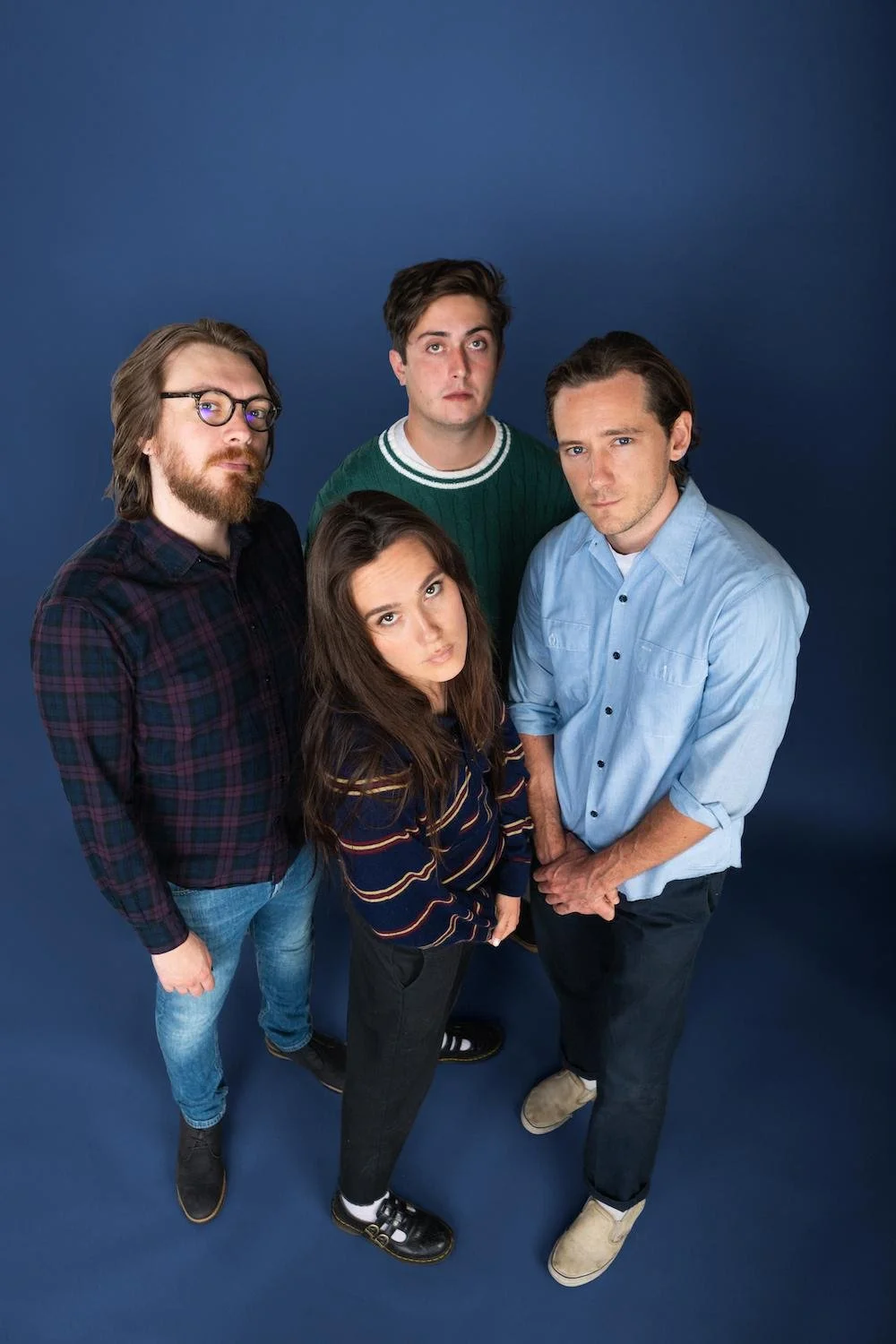
On this edition of Snapshots, we’re talking with the Los Angeles indie rock quartet Atta Boy, who just released their latest album, Silt, last Friday. Along with the album, they’ve also unveiled the music video for the title track.
Silt marks the band’s fourth studio album, and they’re celebrating its release with a limited run of shows in San Francisco, Los Angeles, Philadelphia, New York City, and right here in the D.M.V. They’ll be taking the stage at DC9 on July 19—and if you were hoping to grab tickets, you’re out of luck because the show is already completely sold out. That’s just how popular these guys have become.
Please help me welcome Freddie Reish, Lewis Pullman, Eden Brolin & Dashel Thompson – together- they are Atta Boy!
I’m so glad to have you here. I want to start by talking about your wonderful new album, Silt, which came out just a week ago. I’ve been listening to it every day—I absolutely love it, and I’ve been telling all of my friends about it. It’s such a fantastic record.
For those in our audience who are just discovering it, can you take us back to the beginning? What was the genesis of Silt, and what inspired the creation of this album?
Freddie Reish (FR): We started working on this album about what two and a half years ago now, and we worked on it as demos. Sat with it for a while, where there were just versions of just keyboard, guitar, and vocals, and then January of last year, we all got together right over here and got in that room and started recording what is now the album. We were gonna have it be demos and send it to labels, but our managers heard it and said, “Hey, this is this is the album. Just like you guys nailed it. And so, over the course of the summer of 2025, we did overdubs, added new guitar parts. Eden re-recorded her vocals in New York. Lewis and Dashiell kind of came in and out, recording more drum parts and more key parts, and then we sent it to get mixed by Bradford Kreiger, and then yeah, here we are now.
That’s wonderful. From what you’ve shared, it sounds like the album was recorded in several different locations. How did that process shape the final record? Even though everyone was working from different places, the album feels incredibly cohesive. What helped you bring all of those pieces together into such a unified sound?
FR: So, we’ve kind of been doing it this way for a while, where we’re we’ve since like literally after we recorded our first album, we all spread out, and so for the past like 14 years, we’ve been working together from different places, so we’re kind of used to it. It’s lots of voice memos, lots of Facetimes, and then usually we find time for about like two weeks to all get together to create like the heart of each song, and then we can kind of add on to it and send it and have notes and kind of just edit it from there.
Eden Brolin (EB): This is the first time that we had done a record where we were recording things separately. At times, we usually were we’re pretty used to writing things remotely and sending things back and forth, which is what Freddie was saying. And this is the first time that we kind of got to like let things breathe a little bit more because we weren’t having to get a record done in such a concentrated amount of time, which I think has its own advantages and like sort of can create like an interesting exercise in itself.
I think it was really nice for us to be able to like let some of these ideas have some breathing room because I think we were tending to try to go like as extreme or exaggerated with certain ideas as possible, and then sort of learning ourselves how to like pull them back and we were able to sort of do that with like time and I think you know there’s something nice about having individual space to like work something out and send it where you’re not in the same room and having to share these very vulnerable ideas sometimes so I think that was definitely a. That was definitely an interesting help for this record and new experience for us.
It sounds like many cooperators are trying to create the book, creating different chapters, and then when it comes together, you got one wonderful book to present out to the world.
It really is remarkable, especially considering that you’ve all known each other for half of your lives. Most of you have been friends since middle school. I’m curious—what was the turning point? How did you go from being a group of friends hanging out and jamming together to becoming the indie rock band you are today? When did you realize this was something you wanted to pursue seriously?
Dashel Thompson (DT): Freddie, Eden, and I, like you said, were in kind of homeroom together in middle school. Lew came to the school in seventh grade, and we kind of were in friend circles with each other. Its kind of in and out. It’s a really small school, so everyone knew what everybody else. But Freddie and I were also in band together in school for a number of years, and then finally we’re like, “hey, we should like make music together outside of this,” We tried a bunch of things. None of it really ever worked, but we had fun.
But at some point, we were like, “Hey, we should probably get like an actual singer. We don’t have the best voices, so let’s get someone who can actually sing.” And we’re like, “What about Eden? And so, Eden graciously decided to join us. Yeah, despite probably what we didn’t have a lot to offer at the time, I don’t think, but she said yes anyways, which was cool. And Lewis was also in band with us, and so we needed a drummer, and he was the natural the natural choice. And the rest was kind of history.
It’s all good. Lewis, how long did you play the drums before um actually joining the band?
Lewis Pullman (LP): Oh gosh, on and off since like since like fifth grade or something. It was just a fun experimental kind of like friends doing it for fun. That’s just where the best things are kind of formulated from is when the intention is just for yourselves. I feel it’s such a good kind of starting place, so that you’re not the intentions are all in the right place.
In fact, it was around the time knowing that you guys played in the middle school. I played the trumpet around fourth grade, and then by the time I went to high school, TV production came into life, and I ended up being a reporter for some reason.
Amazing, what a switch!
It is quite a switch. And what I love about listening to not only this album, but previous albums were some of the great musical tastes. I like to know from that each of you who were some of your musical influences growing up. I’m going to start with you, Freddie.
FR: Well, I think a similar one for all of us was Dr. Dog in high school. I think they’re still the band I’ve seen play the most and the Strokes a lot in high school. We really into indie rock in high school. So like around that time, Alabama Shakes just started. The Head and the Heart was big at the time.
EB: How do you not say the Beatles? I don’t understand that.
LP: That is part of your DNA and bones. It’s just like because it’s so obvious. I love the Beatles so much. They’re great. It’s interesting you ask this because I just found out that we’re kind of gonna do some like individual playlists about our what kind of shaped us. I think as a drummer was different than what I wanted to play as a musician. I mean, you know loved his Beatles. My version of his Beatles was probably Led Zeppelin.
I loved The Band and Levon Helm, one of my all-time favorite drummers. I kind of started there, but then I was yeah obsessed with Dr. Dog. I was obsessed with those guys. I wanted to kind of find a way to bring the rock and roll into the indie, that whole that whole hybrid was really my whole jam. And then I love the funk. That’s all I can really dance to because my mom listened to a lot of Al Green and Earth, Wind, and Fire growing up, that like trying to bring in some funk whenever you can get the chance. It’s also the most fun genre to play drums to.
DT: I think one of the early musical things that he and I shared was a love for The Beatles, that was definitely one of the impetuses. One of the things that brought us together as musicians was a shared love for the Beatles. If you ever hear an Atta Boy song and you’re like, “I think they’re doing a Beatles thing,” it’s probably because Freddie and I had a large hand in writing in writing that song.
So, but beyond that, my mom has always really been into prog rock, and so there was a lot of prog rock playing in the house. I didn’t always get into the stuff that she was playing. She loves Genesis, old old Genesis. So like we’re talking like selling England by the pound and Lamb lies down on Broadway. That kind of era of Genesis. But I was more into like Pink Floyd and King Crimson was the stuff I really liked. And then when I started getting into like the indie stuff again, Doctor Dog, Wilco was really important. House, I listened to so much Beach House. I think I’m always kind of trying to shoot for in terms of like synth sounds. I don’t think anyone does it better. They just have such like incredible the like richness of all of the keys. It’s the textural stuff that that that they do is so incredible. Grizzly Bear was big, all that kind of stuff.
EB: I grew up listening to you know um my dad playing a lot of Pearl Jam and Tom Waits and my brother introduced me to like Björk and Joanna Newsom at a young age. I think I was really inspired by like vocalists like Aimee Mann pretty early on, and then I loved India.Arie. As we were doing these playlists, I was just revisiting like what an absolute obsession I had with India.Arie. She’s just such an incredible vocalist and songwriter. I think especially has sort of like inspired some of the like healing themes that I think are fun to sort of like hide into our lyrics as a band who has like kind of evolved together and had to go through some pushes and pulls together. I think those are kind of the like that’s a sort of basket that I could hand you of some early ones for sure, and then all so much of what they said too, of course.
You all have such an eclectic collection of influences that I may have to listen to each and every one of them after this interview. Now, will this be your first time performing in the DC metro area?
DT: Second time, I believe. If I’m not mistaken. We actually played at DC9 two years ago.
EB: Yeah, such a great show. It was such a sweet audience and so fun.
FR: Great venue. They have a Darth Vader disco ball.
I remember reading in the bio, was that it says “a song’s meaning once written will turn out differently once it’s fleshed out. It can shift depending on where you are personally, physically, geographically.” And when I read that quote, it resonates with me with all I’ve done in my media work for over 20 years now. I want to know what that quote resonates with you all.
EB: I think this can come with sort of any medium of art, whether it’s whether it’s a piece of physical art or a movie or a song or a whole record, but I feel like getting to revisit something at different points of your life when you’ve experienced different things is like is so magical how it can like change. There’s a kind of alchemy that happens in tandem. With like your own sort of evolution and how you bring a piece with you on that and how it’s there’s this like magic to the fact that that is going to be inevitably different for every single person even if they’re having a similar experience.
I think that there’s something really like magical about that. That definitely for me applies to like songs. You might hear songs in a musical way when you initially hear it, and then as you get older, you suddenly like hear a certain verse or you hear the chorus in an entirely different way in the context of the rest of the song. I feel that way about the movie Magnolia. I don’t know if you’ve ever seen Magnolia.
Yes, I have, Paul Thomas Anderson.
EB: I probably watch it every like three to five years, and I experience it so differently every time I watch it, just because of whatever chapter of my life I’m in and how like how the themes hit differently. So that’s what I get from that from that quote, and just what kind of a magic that that is that we get to like experience with whatever art we’ve seen is pretty cool.
That’s very definitive answer. What would you like to say to any upcoming artists who need that confidence, that boost from an established artist?
LP: I think it goes back to doing it for yourself, like doing it, starting in a from a place of what you want to hear, what you want to play, and that being the most important kind of breeding ground for creativity.
DT: That’s exactly it. I think you can’t go in expecting some grand thing. I think you have to do it exactly for the right reason, right? And be willing to do the scary thing of being vulnerable, of trying things that make you uncomfortable, going beyond your comfort zone. I think that’s always made our music better. Has been the process of doing something scary, of doing something uncomfortable. I think with this record especially, made an effort to push ourselves past the like known knowns, the things that we knew were true and we knew that were comfortable, and to say like, what if we scare ourselves a little bit?
EB: The willingness to have a bad idea or the wrong idea, whatever that means. But like, I feel like people can quit a lot because of perfectionism and just fear around like having an idea that doesn’t quite make the cut. But like that really is where the good stuff is.
You can follow Atta Boy on their social media to see if they are coming to a city near you
- Website – Atta Boy
- Instagram – @weareattaboy
- YouTube – Atta Boy – YouTube
About The Author